Showing posts with label Wayne Shorter. Show all posts

January 30, 2016

Lee Morgan's Search for the New Land: Superb Hard-Bop From 1966

When someone asks me: What's the best Lee Morgan (1937-1972) album? Typically they expect The Sidewinder answer to come out of my mouth.

I can certainly agree, that album is one of the best, and perhaps even equal to my favorite:

Search For the New Land:

A sextet album recorded in 1964 but released 2 years later, and yes it does sport a stone classic jazz line up:

Lee Morgan on trumpet, Herbie Hancock on piano, Wayne Shorter on tenor sax, the underrated Reggie Workman on bass, the superb Billy Higgins on drums, and for my money, the best jazz guitarist of them all Grant Green.

I love the solo Grant takes on the title track, the track is well worth the 15 minutes. Green's solo happens at the 9:15 mark if you listen to the video below.

Hearing the solo in context with the other great solos from Morgan, Shorter, and Hancock is what drives the point home, wow the clean no-B.S. sound is what sets green apart in my opinion.

When I see a Blue Note with Grant Green as a side man, I know it will be a good session.  I know Green will contribute something worthwhile for my ears.


The centerpiece of the album is of course the title track, but believe me there are plenty of reasons to like the album. "Mr. Kenyatta" is nice tune, darned if Green doesn't kick butt again. I love the urgency of the track.

Lee delivers one of my favorite fiery solos on the track "see below", he really digs in on the track stretching the boundaries, the theme on "Mr Kenyatta" is really inventive hard-bop. This album in my opinion is the pinnacle of where hard-bop could go before going out side to the avant-garde.

The Ballad "Melancholee" seems like a Wayne Shorter vehicle, or least that Wayne was in Lee Morgan's mind when it was written. Wayne's playing and the composition has this enigmatic quality to it. I wonder if that would be the same if Joe Henderson was in the tenor spot?

"Morgan the Pirate" is another great advanced hard-bop tune, Shorter and Green do their thing again. These guys were so in the zone in 1964, they were all fresh and creative, pushing themselves beyond where anyone could have conceived the music from a contemporary perspective. I can certainly see why Shorter and Hancock went the fusion route later on by the end of the decade.

 Listen to this record, or any of Herbie, Wayne, or Lee's other records of the 63-67 period, what else can you do inside the bop/hard-bop tradition?

The logical place would be to go to other styles like world music and popular music for inspiration...and ultimately the use of electronic instruments is what they did.

Search For the New Land is certainly one of the best hard-bop records I have ever heard, and fits nicely inside the post bop sub-genre, though the music never becomes too high-brow for the less than well healed jazz aficionado.


December 31, 2015

Odyssey of Iska: Wayne Shorter's Pre Weather Report Avant-Garde Jazz Rock Blue Note

Odyssey of Iska
Wayne Shorter wrote in the liner notes: "Iska is the wind that passes, leaving no trace..."

I like that statement, it also aptly describe the mysterious quality in Shorter's sound, both as a writer and as instrumentalist.

Odyssey of Iska recorded in August of 1970 presages the work the work Wayne would do with Weather Report shortly there after.

 It also has a heavy influence of Miles Davis' In a Silent Way and Bitches Brew, both of which Shorter participated on.

Iska is a suite in a sense: "Wind", "Storm", "Calm", "Depois do Amor, o Vazio" (After Love, Emptiness), and "Joy" chronicle a persons spiritual journey through trials and tribulation, then the gradual understanding and finding of truth along the way. Wayne points out some people never quite get there.

 I believe the "journey" of trying to improve is actually finding God, "be still and know". Objectively observing your surrounding, without prejudice. Staying in control, and not reacting negatively to forces that try to control you is in a sense finding God.

Of all the jazz musicians I follow Wayne's thinking is pretty close to my own, I find his writing and interviews to be incredibly fulfilling. I have actually learned a few things from him beyond music.

I don't want to get bogged down in trying to describe this music track by track, an impossible task by the way.

Iska is a chamber jazz fusion album. Much more avant-garde than the rock element might make you suspect. "Depois do Amor, o Vazio" (After Love, Emptiness) is the most commercial track here, offering a lovely island dreaming bossa nove vibe.

The rest of the album is some rather challenging post-bop meets fusion styles, with ebbs and flows throughout. Never atonal to my ears,  just different and unique.  Other than Wayne's soprano sax and some tenor, guitarist Gene Bertoncini is the real standout. Bertoncini is not flashy at all here, but his playing is a compliment to the music.

Dave Freidman's Vibes and Marimba add to the mysterious "Shorter" sound. Ron Carter and Cecil McBee do things on bass, that well, I am not at all sure who's who.

 These soundscapes are rewarding and demand repeated listens. My favorite track is the raucous propulsive "Joy" featured below.


December 14, 2015

Wayne Shorter's Most Avant-Garde Blue Note Album: The All Seeing Eye

Wane Shorter All Seeing Eye
Back 20 years ago or so when I first started getting into modern jazz:

It was always a shock to the system when I'd discover an artist and be into a certain style of music that was more commercially accepted, only to be turned upside down by a different more challenging sound.

I think the first Shorter album I checked out was Speak No Evil, then Adam's Apple. When I finally worked my way over to this complex masterpiece The All Seeing Eye, I was shocked.

I didn't easily take to the avant-garde styled jazz, actually, ironically I did early on like free jazz of the Coltrane's Ascension variety, pure aggression some of that music is, and it just seemed to be easily understood to me.

Albums like Dolphy's Out to Lunch, Andrew Hill's Point of Departure are composed pieces in a purer sense, at least they sound that way to me. I had a harder time understanding the chamber jazz style. 1965's The All Seeing Eye is Definitely chamber jazz.

It would be asinine on my part to try to explain this music track by track, other than perhaps the moods and tempos. This is music that takes many listens to digest.

For what it's worth, this is the album I feel Wayne sounds the most like Coltrane, he digs into his solos with more earnestness, an less mystery perhaps?

This music is not that far removed from what Wayne was doing with Miles Davis at around this time. pianist Herbie Hancock and bassist Ron Carter offer support along with Joe Chambers on drums. The Music is definitely more experimental, and less melodic than the Davis quintet material.

What makes this album so special are the horns, Shorter, trombonist Grachan Moncur III, James Spauding on alto, and Freddie Hubbard on trumpet, they all get to stretch out here.

Then there's Allan Shorter, Wayne's older brother playing flugelhorn on his own composition "Mephistopheles". A bizarre monotonous droning track that settles into a drum beat that will pound your head to Excedrin headache number 9.

Ultimately this album is fantastic if you like cerebral avant-garde style jazz. I know some will think music like this is pretentious, but really, how can you fault an artist for creating music he wants to as an artistic statement and not necessarily as a pay day? 

Shorter, in the liner notes for the album exclaimed that he had God in mind when creating this music. "Titles like "Genesis" "All Seeing Eye", and "Chaos" bring this to the forefront. Then his brother's "Mephistopheles", which brings in the devil and the struggles with that force, so you can see, this is thinking people's music, it's chamber jazz.

Do you dare to battle The All Seeing Eye?


December 13, 2015

Wayne Shorter's Night Dreamer 1964: His Blue Note Debut is One of His Best

Wayne Shorter Night Dreamer Review
The Thing that struck me about Wayne Shorter's music right away, was his unique ability to sound enigmatic.

For me it's like there is something in it that I can't always find the answer to. His music always seems to have a depth beyond the typical.

Coltrane is this way too, all the masters I suppose are, but Trane and perhaps Miles Davis are more earnest in their composing.

 Shorter is enigmatic at his core, as a writer and as musician, it adds something to his music, I like it.

You can hear a lot of this mysterious quality with his work with the Jazz Messengers, but Art Blakey probably tempered that a bit, at least any avant-garde leanings?

Those early Vee Jay sessions also seem to not quite be on par with this Blue Note debut Night Dreamer.

With Wayne or Tenor, pianist McCoy Tyner, trumpeter Lee Morgan, Bassist Reggie Workman, and Elvin Jones on drums it's hard to lose session.

If you consider Night Dreamer, and the rest of the Blue Notes during the mid 60's along side all the work with Miles Davis quintet, Miles Smiles and Nefertiti especially, you're talking about a monstrous force in jazz history. Really as of 2015, is there any doubt who the greatest living jazz composer is?

Night Dreamer is one of Wayne's best albums, and in my opinion underrated. I like it nearly as much as Speak No Evil and better than Ju Ju.

The Album still has a foot in hard bop, but barely. It is very much post bop and heavily modal. Wayne is also very muscular sounding at times and of course searching and yes, very enigmatic on the lower tempo numbers.

The title track begins with pianist Tyner and then the theme is stated. Right away we get a nice solo out of Wayne, inventive and robust. Lee Morgan is a nice change of pace on trumpet here, more bop oriented than say Freddie Hubbard, perhaps not as searching as Wayne, but the contrast is nice.

"Virgo" is a contemplative ballad. Admittedly reminds me of Coltrane quite a lot, "Naima" pops into my head, but you shouldn't confuse the two.  Dexter Gordon also clearly has influenced Wayne. You'll love the little solo outro on "Virgo".

"Armageddon" is my favorite on the album, it ebbs and flows and summons an ominous vibe. Finally after playing with you, Wayne rips into a nice solo, one of the best on the album. This track sort of sums up the entire album.


The rest the album, "Charcoal Blues", "Oriental Folk Song", "Black Nile" have the same mysterious quality as the highlighted tracks, the latter "Black Nile" being my favorite, Wayne stated that he wanted the track to sound like a river flowing. The album to my ears sounds like an unfolding story in 6 parts.

Original NY USA copies of Night Dreamer ain't cheap right now, in 2015, were talking two- hundred dollars for openers, going forward these are going to climb through the stratosphere.

Don't forget to subscribe via email if you liked this post.

November 18, 2015

Wayne Shorter's Schizophrenia: One of the Saxophonists Most Overlooked Blue Note Albums

http://www.amazon.com/gp/product/B00VXMUK5Y/ref=as_li_tl?ie=UTF8&camp=1789&creative=390957&creativeASIN=B00VXMUK5Y&linkCode=as2&tag=blogger-bluenote-20&linkId=75MUTGFDT3XQ4G2P
1967's Schizophrenia is a great album, just the right amount of inside/outside jazz. Equal parts of both.

 By this point Shorter is the master of the enigmatic sound. Everything seems to have a mysterious quality.

The standard "Tom Thumb" with its catchy line is one of the best in Wayne's discography.  Schizophrenia sounds like an extension of the Davis second great quintet to my ears.

The music is exploratory, though never loses the symbiotic relationship with the mother ship of jazz.

With Herbie Hancock on piano, and Ron Carter on Bass you know you're going to get a dose of the Davis mid-60's band sound, minus Miles of course.

The horns on the album, beside the leader Shorter's are: James Spauding on alto, as well as flute, and the great Curtis Fuller on trombone. Did Fuller ever fail to offer solid work on an album, I can't think of anything bad as sideman or leader?

Spaldings "Kryptonite" , the only tune not composed by shorter on the album is a nice flute show piece until Shorter does some muscular runs of his own. Carter does some strutting around too,  similar to the Plugged Nickle concerts he did with Davis. Carter had a stretchy bass style, he could fly all over the board.

Drummer Joe Chambers, who's a pretty darned good composer in his own right just sticks to drums, but he plays in a very similar style as Tony Williams.

The thing that strikes me about Schizophrenia is how aptly titled the album is, it does very much straddle the dividing line of free jazz and bop. 1967 was the year of release here, and the music is being stretched to such lengths, you begin to wonder where else can they go?

Shorter and Davis were at this time also releasing albums like Miles Smiles and Nefertiti to the masses. Hancock was releasing Maiden Voyage, "earlier", with The Prisoner about the same time.

Eventually, within 3 years Shorter was off to co-found Weather Report with Joe Zawinul, and Herbie Hancock was on his way to forming his Mwandishi band delivering great jazz funk fusion like Crossings for Warner Bros. and Sextant for Columbia.

Shorter actually rode with Miles up to March of 1970, all the way through Bitches Brew. 1971's Live in Tokyo from Weather Report has a feel that reminds me of Schizophrenia some, all be it with electric piano, and a more improvised and less structured approach.

It is interesting putting music into the historical context of what came before and what came after, and of course what was being played by that particular artist, and what his contemporaries were playing at the time.

Obviously you have to spend a lot of time reading about and listening to this music to go that far down the rabbit hole with it. But, when you do, you are able to hear new things with each listen, and it is a very rewarding experience for me, perhaps you too?

 This allows a fan to perhaps experience some of that development the artist has made throughout his career.

We music listeners, especially with a genre as demanding as modern jazz might also experience the developing of  our listening tastes for diverse sounds, much like the artist develops his playing style from his own influences.


"Miyako"is a ballad that is a real revelation "see below". Funny how much the Lester Young influence comes out on this, not until this very day did I realize how much Shorter's enigmatic tone sounded like young.

I am going to have to listen to some more Lester Young tonight to see if I am right. Shorter really reminds me of him on the ballad, pretty straight ahead. Hancock does a nice job staying tasteful as always behind Wayne.

The final track "Playground" gets off to a pretty atonal start, more Carter fast walking and Chambers' is riding the cymbal. Shorter blasts off into outer space, then falls back to earth like a spent bottle rocket. Fuller offers his best go on the trombone and does a nice job too. An instrument that can be cumbersome seems effortless to the pro Fuller.

October 19, 2015

Art Blakey and the Jazz Messengers A Night in Tunisia: Another Powerful Blue Note Kick in the Teeth

http://www.amazon.com/s/ref=as_li_ss_tl?_encoding=UTF8&camp=1789&creative=390957&field-keywords=a%20night%20in%20tunisia%20blakey&linkCode=ur2&tag=blogger-bluenote-20&url=search-alias%3Daps&linkId=GE24FDTGZWWVBDRI
Recorded and Released in 1960, A Night in Tunisia on Blue Note Records is one of those ass-kicking albums in the Blakey discography that should be in every music collection.

The title track, a cover of Gillespie's "A Night in Tunisia," which features some of the most raucous drum playing you're likely to hear,  and some very good in-the-pocket bass playing from Jymie Merritt.

The title track is best known for its balls-to-the-wall everybody gets some time approach. Wayne Shorter on Tenor, and Lee Morgan on trumpet go bananas, with art egging them on every step of the way.

Blakey is schooling his young players, and they as you might expect, deliver the goods. Damn I wish I could go back in time and see these groups perform live. The secret of these records, why they are so good, they all sound like a live recording, they are full of fiery youthfulness. Like Blakey's Free For All from 1966, the recording equipment almost can't handle the power, Charles Mingus and the early to mid-60's Coltrane quartet is this way too.

I love the unaccompanied solos from Morgan and Shorter, with Art vocally urging them on, it's irresistible. The track is one of those from jazz that made me realize that jazz was not exactly the sterile music of grandpa.

I love Blakey's drumming on these classic Blue Notes, subtle he is not! Heck, that's only the first track, and admittedly the rest of the album is a minor let down compared to the power of the first track, but believe me, the rest is still high-quality hard-bop. Also the 1958 RCA recording of the same name is worth checking out too, alt saxophonist Jackie McLean is in support on that one, and the title track kicks it.

The other tracks:

Wayne Shorter's "Sincerely Diana" charges out of the gate and is typical of the Wayne Shorter sound, reminds me of  something from one of his own Blue Note albums. I love the groove on this track. Morgan again shows why he was one of the best.

 Bobby Timmons' "So Tired" is a nice little funky soulful track, that reminds me of Horace Silver to tell you the truth. Nice theme here. Shorter digs in nicely, he doesn't sound like Coltrane at all here, I never thought he sounded that much like Coltrane anyway, ever.

As Morgan solos on the track I am left digging the bass of Jymie Merritt, what an underrated player. I like the steady pulse underneath the solos. Then he comes out of it walking again, solid!

Lee Morgans "Yama" offers a a retreat from the powerful previous compositions. A soulful blues that soothes the soul. Very tasteful piano from Timmons, and the soft strut of Merritt's bass lead us to Morgan and Shorter's turns, and they turn the heat up a bit. Nice break from the power for sure. I love Shorter on this track, he doesn't offer a cliche at all, the mysterious sound he plays with is perfect, and a bit surprising, I wonder how he was initially taken as a soloist by the general public back then, he's not cliche at all.

Morgan's "Kozo's Waltz rounds out the session. Boy Morgan and Shorter are tight as twins right here, I wonder how many takes this took? This music is from 1960, Shorter seems to be in total control of his tone and phrasing, he sounds like Wayne Shorter all the way.

 I don't hear Coltrane at all in Wayne's playing. People outside of us jazz nuts don't know anything about how great Shorter was and still past 80 years of age. 55 years ago his sound is fully developed,  had he never went on to be the composing spirit of the Davis Second quintet, his legacy was already cemented by these and his own Blue Notes.

Truthfully I always felt Weather Report hurt Wayne's legacy, after the first few albums it felt like Joe Zawinul's game.  I wish Wayne would have had his own fusion band where he was the dominate force. Outside of Native Dancer, which is OK, we never got that. Anyway, A Night in Tunisia on Blue Note is a must have in every serious jazz collection.


June 24, 2012

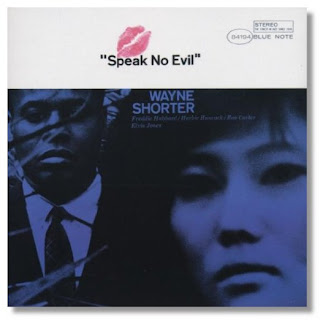
Wayne Shorter Blue Note 4194 Speak No Evil (1965)

http://redirect.viglink.com?key=7f4b0b133ef875ccddfa32e340a55e1e&type=bk&u=http%3A%2F%2Fwww.ebay.com%2Fsch%2Fi.html%3F_odkw%3Dwayne%2Bshorter%2Bspeak%2Bno%2Bevil%26_osacat%3D0%26_from%3DR40%26_trksid%3Dp2045573.m570.l1313.TR0.TRC0.H0.Xwayne%2Bshorter%2Bspeak%2Bno%2Bevil%2Bny%2Busa.TRS0%26_nkw%3Dwayne%2Bshorter%2Bspeak%2Bno%2Bevil%2Bny%2Busa%26_sacat%3D0Tenor Saxophonist Wayne Shorter was a member of Art Blakey's Jazz messengers, Miles Davis' second great quintet, and a co founding member of the jazz fusion super group Weather Report.

His influence on modern saxophonists is immeasurable, he was out of the Coltrane tradition, but Wayne developed his own style and has contributed many Jazz standards.

Speak No Evil, a Blue Note Records release from 1965 is one of the best ever recorded from the label, and one of Wayne's most Influential. To generations of jazz musicians, Speak No Evil is a classic recording. I know have enjoyed Dozens of times.

By this time, Wayne's tone had very little John Coltrane influence left to my ears, All the tunes on Speak No Evil have a Contemporary feel as well , with the Modal bass walking, the Gorgeous melodies, keeping the music from stretching to far into avant guard territory, But that doesn't mean that there aren't any fiery solo's, Shorter and trumpeter Freddie Hubbard have more than a few.

Speak No Evil is about well composed music, this is not a typical "blowing session". One thing that I have learned about this recording that was ground breaking, is the use of perfect 4ths, with the quarter note being emphasized on the title track, McCoy Tyner had been doing this slightly earlier with John Coltrane.

Herbie Hancock plays some very tasteful piano on the album, ultimately Speak No Evil deserves its classic status.

The Title track and "Which Hunt" are stone jazz classics, and "Infant Eyes" is a ballad of impeccable taste.

Original Blue Note NY USA vinyl pressings are fetching upwards of $200 in VG+ condition, even generic 20th Century reissues are fetching $20 bucks a copy.

Speak No Evil


My Blog List

Enter your email address:

Delivered by FeedBurner

If you enjoy this blog, any donations are greatly appreciated:
paypal.me/jjay
Jason Sositko is a participant in the Amazon Services LLC Associates Program, an affiliate advertising program designed to provide a means for sites to earn advertising fees by advertising and linking to Amazon.com.